The Physics Foundation
What the universe actually is: far-from-equilibrium thermodynamics, dissipative structures, entropy, emergence, and the arrow of time.
Educational content, not medical or legal advice. The course discusses health, supplements, cannabis, personal development, and philosophy for educational purposes only.
The Problem with the Physics You Were Taught
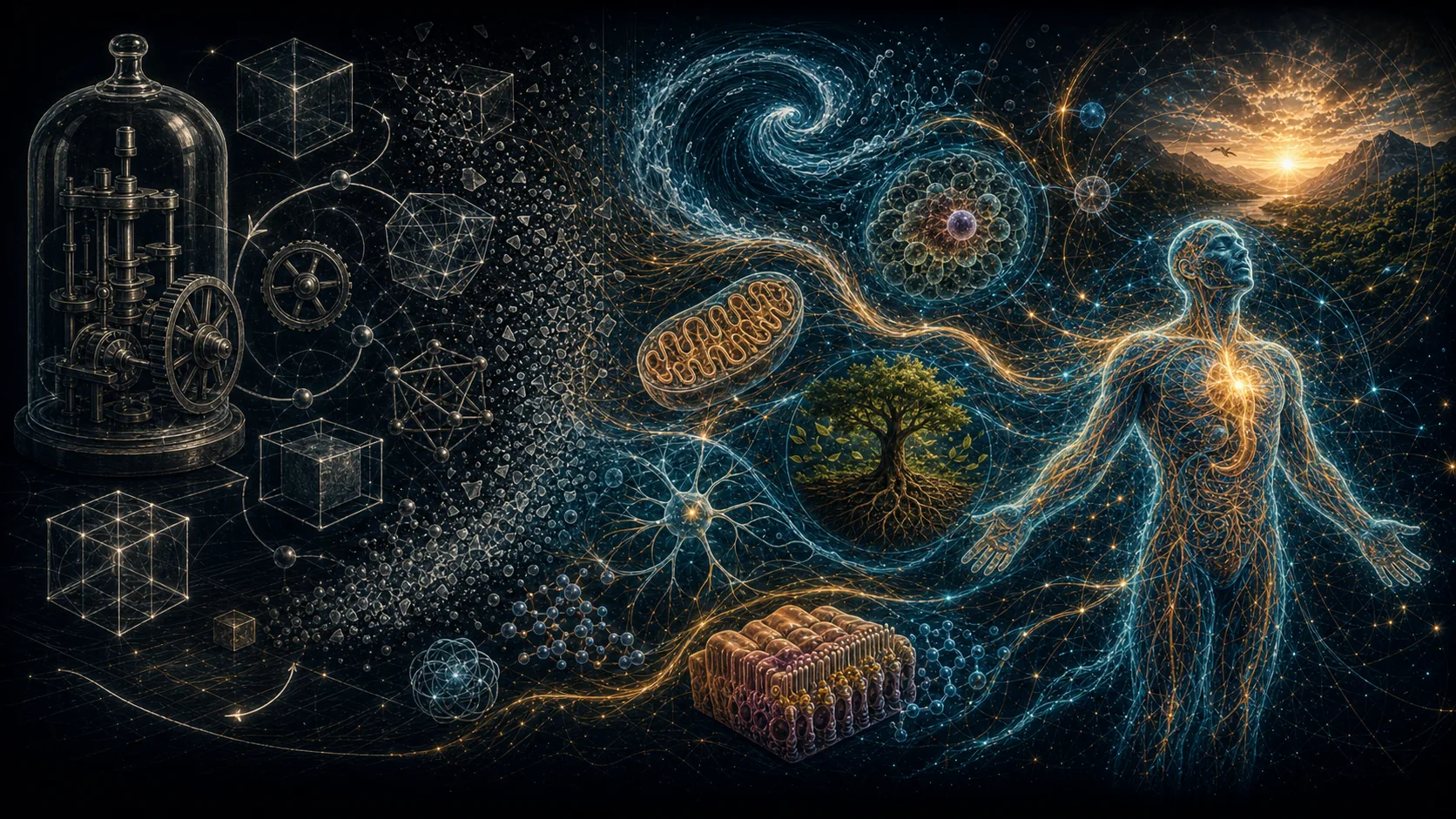
- Open system
- Energy flow
- Entropy cost
- Emergent order
Lesson 1.1.1 The Equilibrium Lie
Start here Every physics class you ever sat through taught you about equilibrium. Balance. Stability. Rest. The universe, you were told, tends toward disorder — toward entropy — and everything moves toward equilibrium, toward sameness, toward rest.
That is true. But it is profoundly, dangerously incomplete.
The physics of equilibrium describes a dead universe. It describes a discharged battery. It describes a cup of coffee that has cooled to room temperature. It describes you, after you've been dead for a week.
What it does not — cannot — describe is you, right now, reading this sentence. It cannot describe a cell dividing. A neuron firing. A hurricane organizing itself from warm ocean water. A forest growing. A civilization being built.
Equilibrium physics says life is statistically impossible. The probability of the molecules that compose your body assembling themselves into the organized, functioning, conscious system that you are — by chance, from a random distribution — is so astronomically small that it effectively equals zero.
And yet, here you are.
The resolution to this paradox — one of the greatest intellectual achievements of the 20th century — was delivered by a Belgian physical chemist named Ilya Prigogine, who won the Nobel Prize in Chemistry in 1977 for work that most scientists still have not fully absorbed. His field: far-from-equilibrium thermodynamics.
Lesson 1.1.2 What Prigogine Proved
Start here Prigogine's core insight was this: when energy flows through a system — when the system is open, not closed — the rules reverse. Instead of moving toward disorder, the system spontaneously moves toward order. Instead of randomness increasing, complexity emerges.
This is not magic. This is not metaphor. This is mathematics. Prigogine developed the rigorous mathematical framework to prove it. Collections of molecules, when energy flows through them far from thermodynamic equilibrium, self-organize. They cooperate. They create structure. They generate patterns that have no business existing from the perspective of equilibrium physics.
The key phrase is far from equilibrium. Not at equilibrium, where nothing happens. Not near equilibrium, where only small fluctuations occur. But far from equilibrium — in the turbulent, energized, dynamic zone where molecules are forced to solve the problem of managing excess energy. And the solution they arrive at, again and again, at every scale, is: build something more organized.
As Dr. Bob Melamede explains: "Collections of molecules get smarter as long as they make the universe stupider quicker."
Core lineThis is the most important sentence in this course. Read it again. Let it land.
You — your body, your brain, your consciousness, your civilization — are a system that maintains its internal order by exporting disorder to the surroundings. You eat food (ordered, complex molecules), extract their energy, and release heat and waste (disordered). You breathe in oxygen and breathe out carbon dioxide. You take negative entropy from your environment and use it to maintain and grow your own organization. In doing so, you increase the entropy of the universe as a whole — you make it "stupider" — but locally, within the boundary of your skin, you maintain, and can even grow, order and complexity.
Core lineThis is not just what you do. This is what you are. You are a far-from-equilibrium process.
Lesson 1.1.3 The Bernárd Instability: Seeing It with Your Own Eyes
Start here Consider a petri dish of oil heated from below. According to equilibrium physics, the molecules should distribute randomly. Heat faster, random motion faster — nothing else. The system should remain homogeneous.
Instead, something extraordinary happens. At a critical threshold — when the temperature gradient becomes steep enough, when the system is pushed sufficiently far from equilibrium — the molecules spontaneously organize themselves into hexagonal convection cells. Hot molecules rise along the edges of each hexagon, cool at the top, and descend through the center. Billions of molecules, with no central coordinator, no blueprint, no instruction manual, collectively create a geometric pattern of stunning regularity.
Core lineThis is called the Bénard Instability. It is one of the simplest demonstrations of a profound truth: flowing energy organizes matter.
The Belousov-Zhabotinsky (BZ) Reaction is another example. In a chemical solution, with the right reactants, beautiful oscillating waves of color spontaneously appear and propagate across the dish. In the 1950s, when Belousov first tried to publish this result, journal editors rejected it. Their reasoning: this would violate the Second Law of Thermodynamics. It was impossible.
It wasn't impossible. They were wrong. They were applying equilibrium thinking to a non-equilibrium system.
Lesson 1.1.4 From Chemistry to Life: the Great Continuity
Start here Prigogine's profound contribution was recognizing that this self-organizing property of far-from-equilibrium systems scales. It is not limited to chemical solutions in petri dishes. It applies at every level of organization:
Prebiotic chemistry → energy flows through complex chemical soups, molecules self-organize into more complex molecules. Over billions of years and countless iterations, the complexity accumulates until a threshold is crossed: the far-from-equilibrium phase change we call the origin of life.
Single cells → far-from-equilibrium biochemical systems, maintaining their organization by consuming food and expelling waste. Your mitochondria are the power plants that keep the system running.
Multicellular organisms → cells communicate, cooperate, specialize. Organs form. Systems emerge. The whole becomes greater than the sum of the parts.
Ecosystems → organisms in relationship, each one a dissipative structure consuming and expelling energy, the whole web maintaining itself through flows of matter and energy.
Societies and civilizations → the same physics, operating at the level of human organization. Cities are dissipative structures. Economies are dissipative structures. The internet is a dissipative structure. Each one requires constant energy flow to maintain its organization; cut the flow and it collapses back toward equilibrium.
We did not create the creative force of the universe. We are products of it. We are the universe's latest and most spectacular expression of its fundamental drive to organize, complexify, and create.
Dissipative Structures — What You Are
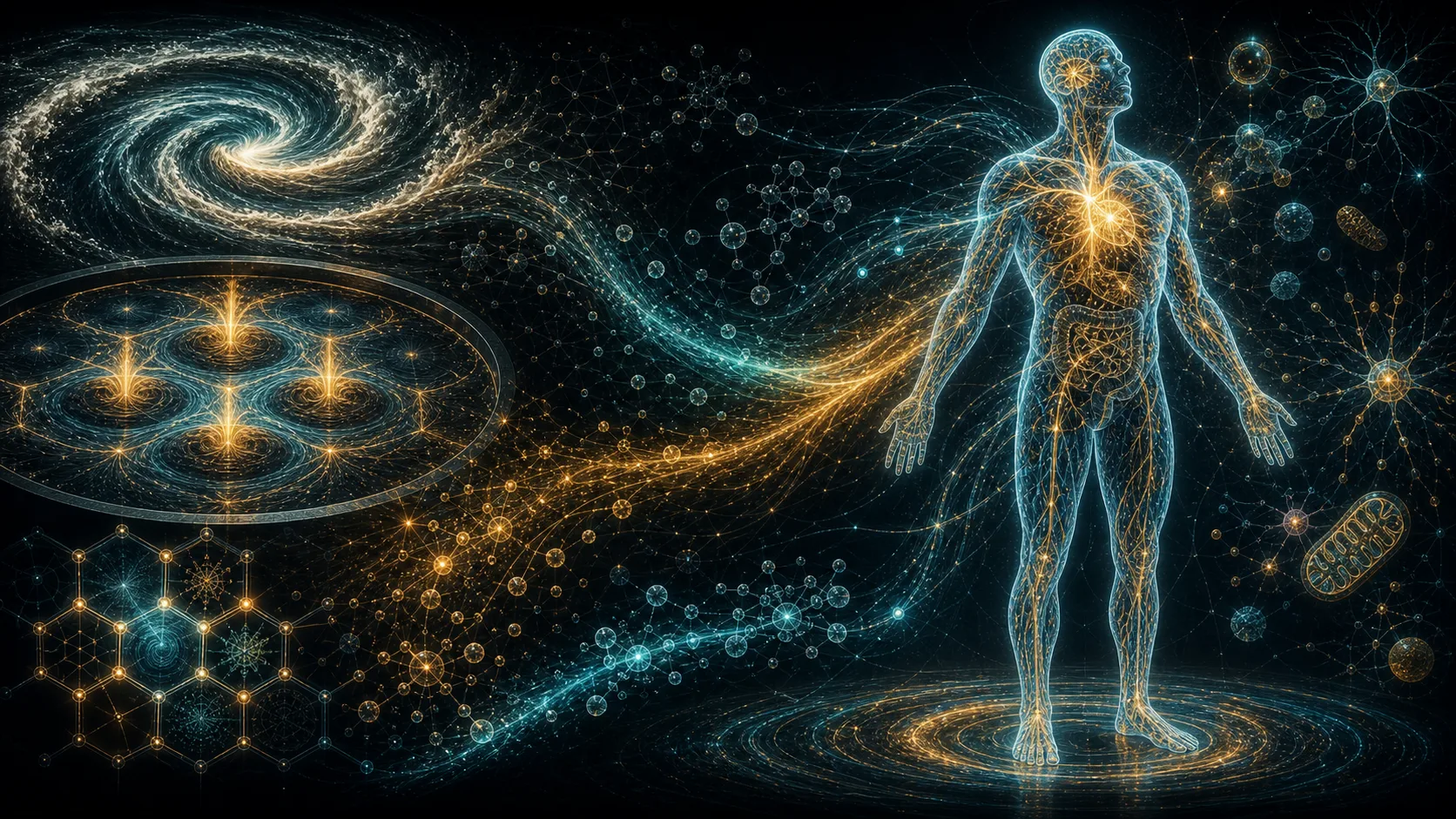
- Open system
- Energy flow
- Entropy cost
- Emergent order
Lesson 1.2.1 The Definition
Lesson 1.2.2 The Hurricane as Teacher
Start here You are a hurricane. You are not made of specific atoms — the atoms in your body are completely replaced over time. You are the pattern, maintained by flow. Your identity is not a thing; it is a process.
Lesson 1.2.3 The Two Ways to Move Further from Equilibrium
Start here Dr. Bob Melamede identified one of the most important practical insights in this entire framework: there are only two ways for a human being to decrease their entropy and move further from equilibrium.
1. Gain muscle. When you exercise and build muscle, you are literally building more organized physical structure. More organized protein assemblies, more mitochondria, stronger connective tissue. You are, in the most literal physical sense, increasing the negative entropy of your body. Your body becomes more organized, more capable, further from the disordered state of equilibrium.
2. Gain knowledge. When you learn something new, you create new neural connections. Your brain literally becomes more structurally complex. More synaptic connections. More myelinated pathways. More elaborate networks of associated meaning. Again, in the most literal physical sense, you are increasing the negative entropy of your nervous system.
These are not metaphors. These are physics. This is why exercise and learning feel good. Not just psychologically — thermodynamically. Your body and brain have evolved to reward the behaviors that push them further from equilibrium, because those are the behaviors that keep you alive and growing.
Stagnation, on the other hand, is the beginning of death. Not dramatically — slowly. When you stop learning and stop moving, your system begins its inevitable drift back toward equilibrium. The battery discharges. The hurricane weakens.
Lesson 1.2.4 Health, Aging, and Death as Thermodynamics
Entropy, the Arrow of Time, and Irreversibility
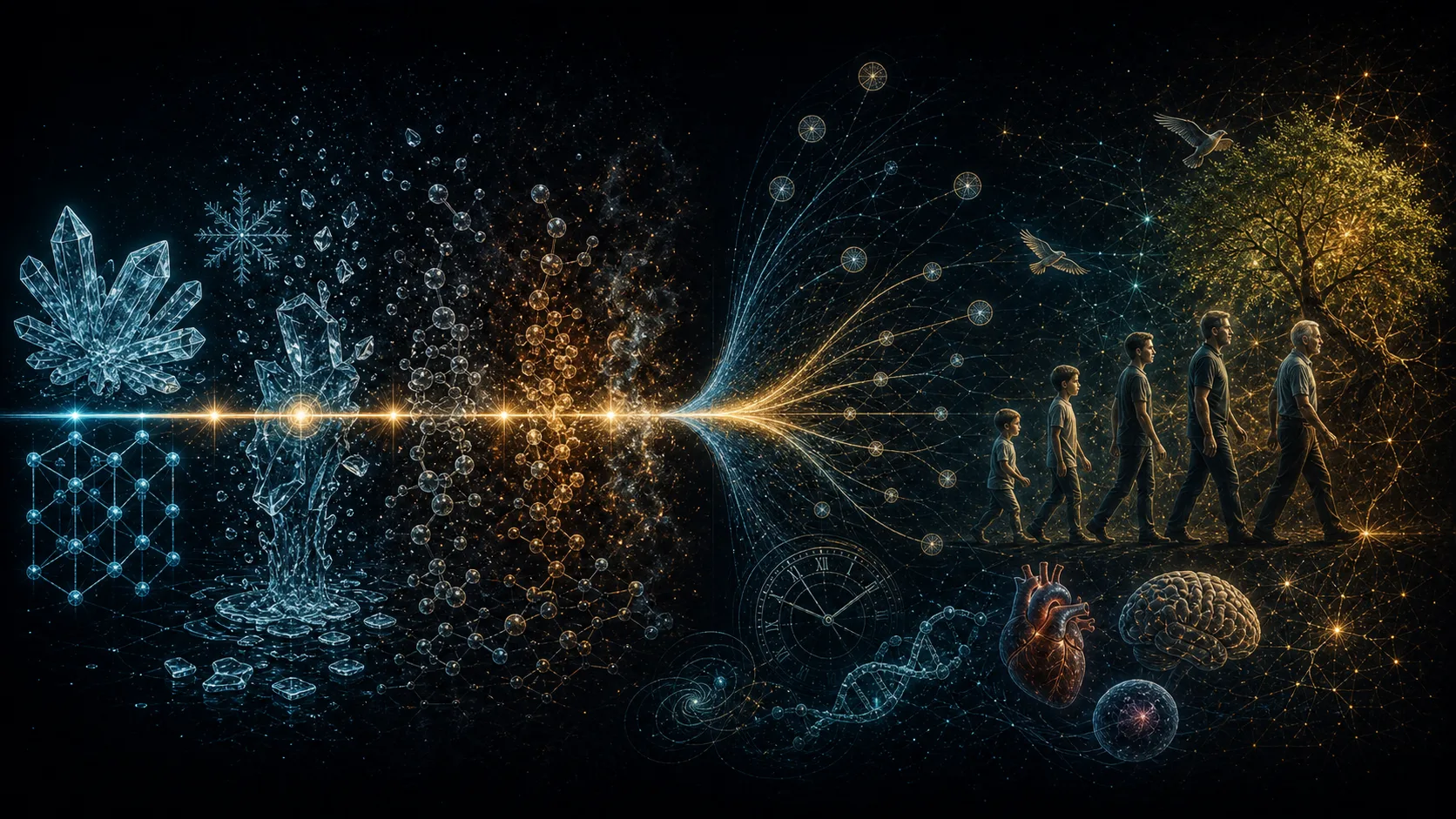
- Open system
- Energy flow
- Entropy cost
- Emergent order
Lesson 1.3.1 The Second Law of Thermodynamics
Start here The Second Law of Thermodynamics states that in any isolated system, entropy — disorder — always increases over time. Everything falls apart. Everything decays. Order requires energy to maintain.
Core lineThis is not pessimism. This is the most important law in physics. Understanding it is understanding why:
You cannot coast. The moment you stop putting energy into your body, relationships, business, or mind — they begin to decay.
The past is truly past. You cannot unbreak an egg, unmix cream from coffee, or unlive a moment.
Growth requires effort. You cannot have more organization without expending energy.
Life is precious. The Second Law is what makes life improbable and therefore remarkable.
Lesson 1.3.2 The Arrow of Time
Start here One of Prigogine's greatest contributions was resolving a paradox that had bothered physicists for decades: the equations of classical physics (Newton, Einstein, quantum mechanics) are time-reversible. They work equally well forwards or backwards. Run the movie of two billiard balls colliding in reverse, and it looks perfectly physical. Nothing distinguishes past from future.
Yet our experience of reality is overwhelmingly irreversible. You get older, not younger. Spilled milk does not flow back into the glass. Memories are of the past, not the future. There is a clear arrow of time pointing from past to future.
Prigogine proved that in far-from-equilibrium systems, irreversibility is fundamental. The entropy-producing processes that keep you alive also make time irreversible at the macroscopic scale. The arrow of time is not an illusion — it is real, and it emerges from the thermodynamics of living systems.
This has profound implications:
You cannot go back. Not to a former version of yourself, a former relationship, a former era. The platform has moved. The past is thermodynamically sealed.
Nostalgia is a trap. BLPs (Backward-Looking People) are swimming to where the platform used to be. FLPs flow with the arrow of time.
Core lineThe future is genuinely open. Because far-from-equilibrium systems exhibit nonlinear, unpredictable behavior, the future is not determined. Small changes now can have enormous consequences. This is empowering, not frightening — if you are an FLP.
Lesson 1.3.3 Bifurcation Points: the Moment Everything Changes
Start here When a far-from-equilibrium system accumulates enough instability — when it is pushed far enough from its current state — it reaches what Prigogine called a bifurcation point. A critical threshold. The system can no longer maintain its current structure and must either:
Evolve into a new, more complex structure (order from chaos, growth), or
Collapse into disorder (dissolution, death)
At a bifurcation point, small fluctuations — tiny, seemingly insignificant inputs — can determine which path the system takes. This is why tiny choices, seemingly small actions, moments of courage or cowardice, can change the trajectory of an entire life.
Dr. Bob identifies the current historical moment as a global bifurcation point for humanity. We are in the pre-phase-change period: wild fluctuations in weather, politics, finance, social norms. The system is becoming unstable. It must evolve or collapse.
The question is which fluctuations win. Which way does the bifurcation go. And that is where FLPs and BLPs come in.
Emergence and Complexity
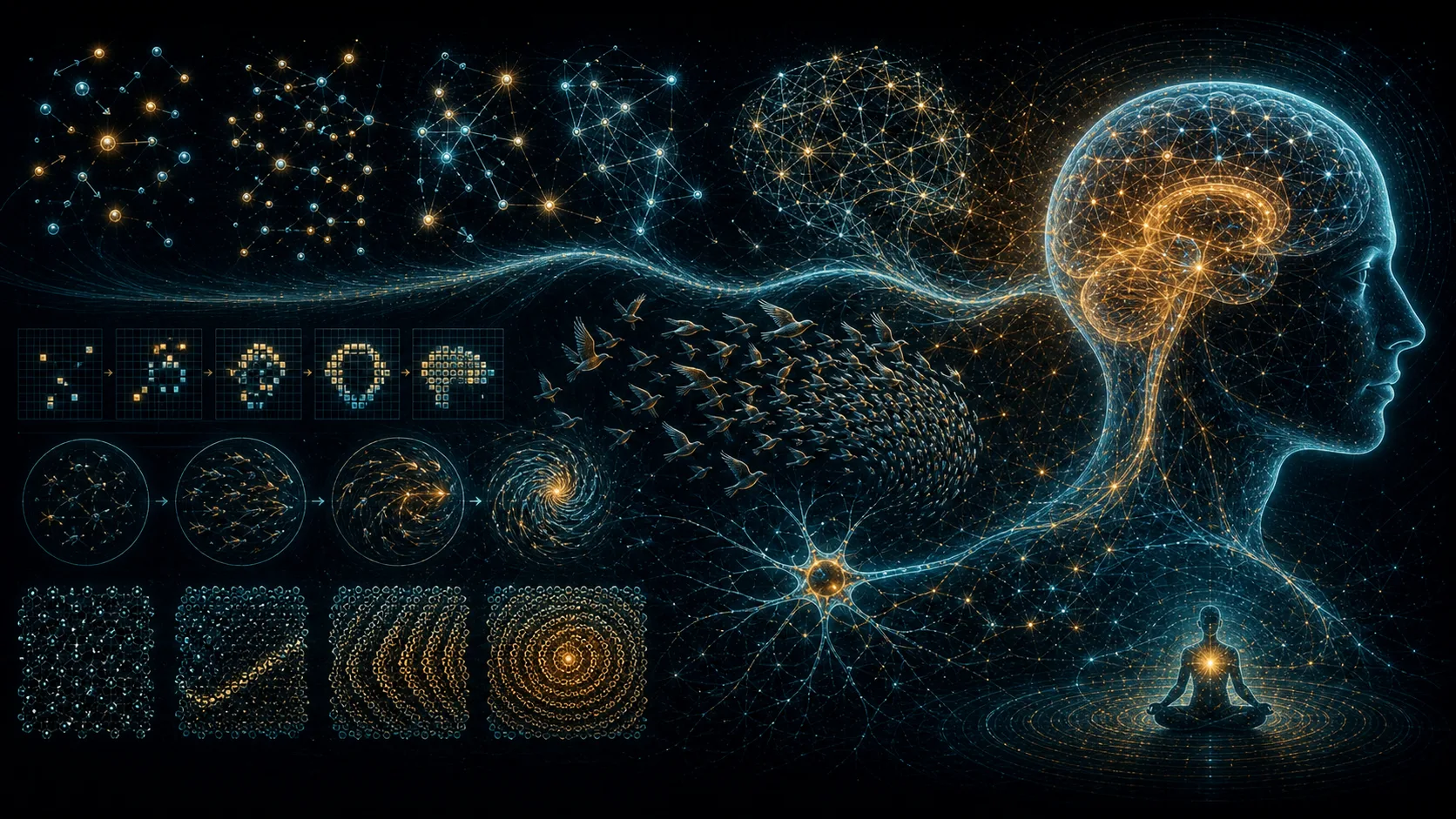
- Open system
- Energy flow
- Entropy cost
- Emergent order
Lesson 1.4.1 More Is Different
Start here One of the defining characteristics of far-from-equilibrium systems is emergence: the phenomenon where complex systems exhibit properties that cannot be predicted from or reduced to their individual components.
A single water molecule is not wet. But bring enough of them together, and wetness emerges. A single neuron is not conscious. But bring 86 billion of them together with trillions of synaptic connections, and consciousness emerges. A single person is not a market. But bring millions of them together making exchange decisions, and prices emerge — spontaneously, without central planning.
Emergence is the universe's creative principle. It is how more becomes different. It is why you cannot understand life by dissecting it into its components, why you cannot understand consciousness by studying individual neurons, why you cannot understand love by analyzing hormones.
The whole is greater than the sum of the parts. This is not poetry — it is physics.
Lesson 1.4.2 Self-Organization: Order Without a Designer
Start here Closely related to emergence is self-organization: the process by which order arises from the local interactions of many agents, without any central coordinator.
No one designs the spiral arm of a hurricane. No one programs the hexagonal convection cells in the Bénard instability. No one writes the code for the BZ reaction's oscillating waves. The order arises spontaneously from the physics of the situation.
This principle has massive implications for how we think about governance, economics, and social organization — themes Dr. Bob develops extensively in his political philosophy. Nature works bottom-up, not top-down. Life works bottom-up. The most robust, adaptive, creative systems are always bottom-up, self-organizing, decentralized. Top-down control — whether in biology (cancer is a cell that stops responding to its community) or society (authoritarian government) — always leads to less adaptive, more fragile, ultimately failing systems.
Lesson 1.4.3 The Edge of Chaos: Where Life Happens
Start here Between pure order (crystalline rigidity, unable to change) and pure chaos (random noise, unable to maintain structure) lies the edge of chaos — the zone of maximum complexity, maximum adaptability, maximum creativity.
Core lineThis is where life lives. Not in rigid, predictable, controlled order. Not in undifferentiated, random chaos. But at the turbulent, dynamic, unpredictable edge between the two.
Core lineThis is also, as Justin Hartfield puts it, where the most interesting things happen. Where the most valuable opportunities exist. Where you learn the most, grow the most, become the most.
The FLP lives at the edge of chaos. The BLP flees it for the false safety of rigidity and the past.
Lesson 1.4.4 Fractals: the Reiteration of Creative Process
Start here A fractal is a pattern that repeats itself at every scale. Zoom into a fractal, and you find the same structure. Zoom out, same structure. The pattern is self-similar across scales.
Dr. Bob proposes that evolution is a dynamic fractal process: each iteration of the evolutionary algorithm — each generation, each species, each ecosystem — takes the output of the previous iteration as its input, produces new output, and feeds that back. The process reiterates, but each time the environment has changed (in part because the previous iteration changed it), so the new output is not identical to the previous one. Genuinely new forms emerge.
This is how you should think about your own development: as a dynamic fractal. Each version of you is the result of the previous version operating in the world, changing the environment, and being changed by it. You are not trying to repeat a pattern — you are trying to allow the creative process to reiterate, producing genuine novelty at each step.
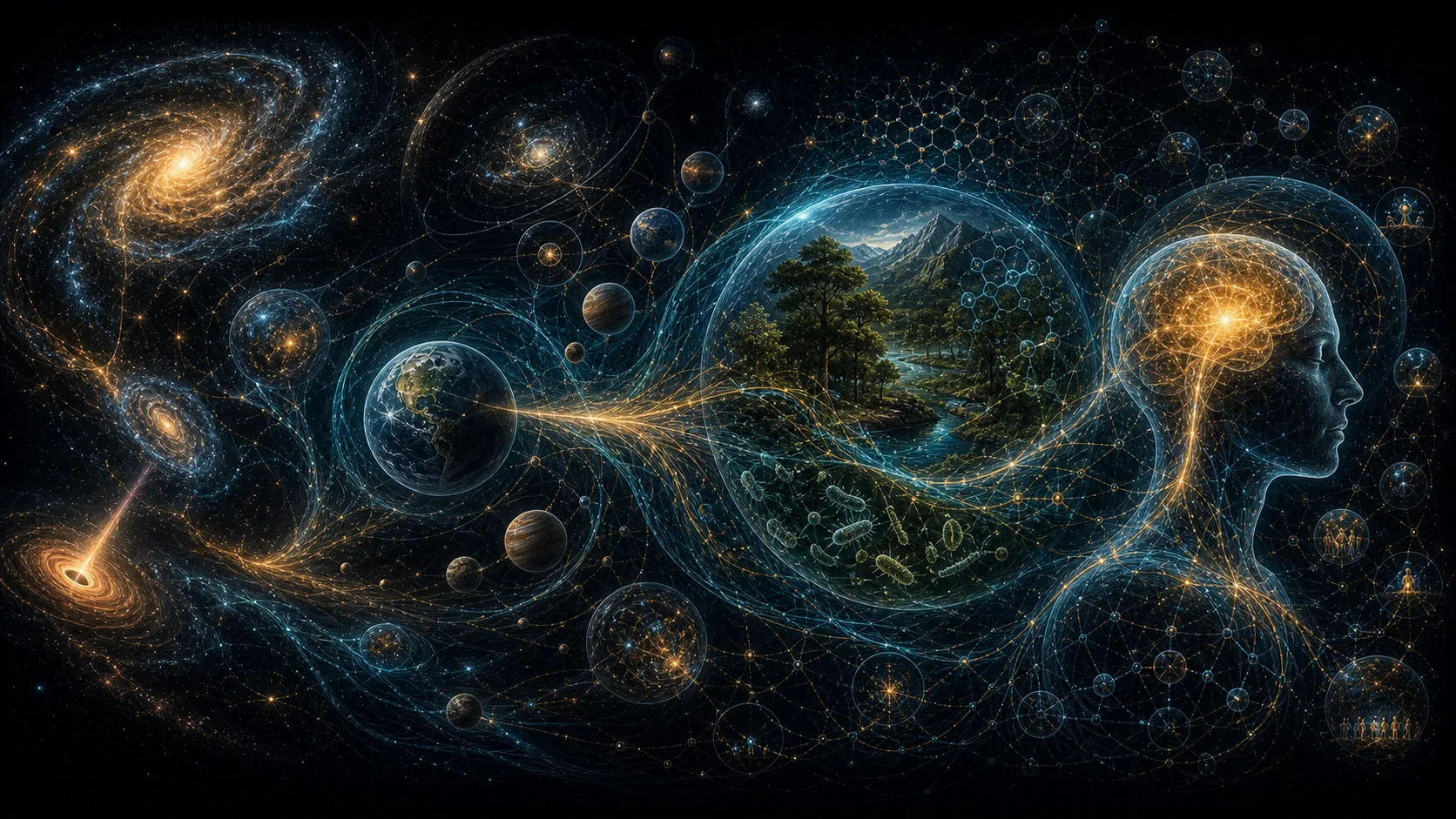
The God Question — Generalized Open System Dynamics
- Open system
- Energy flow
- Entropy cost
- Emergent order
Lesson 1.5.1 What Dr. Bob Means by "god"
Start here Dr. Bob Melamede, when asked about God, doesn't reach for a Bible or deny the question. He says: "For me, God is Generalized Open System Dynamics."
This is not reductionism. It is expansion. He is saying that what people throughout human history have called God, the divine force, the creative principle, the ground of being, the Tao, Brahman, the Force — is precisely the far-from-equilibrium thermodynamic process that drives the self-organization of the universe.
The universe has an intrinsic creative nature. Energy flowing through matter spontaneously generates organization, complexity, consciousness. This is not random. This is not accidental. This is the fundamental character of reality.
You don't need a bearded man in the sky to explain why the universe produces life and consciousness. The physics demands it. As Prigogine proved: given energy flow and the right conditions, life must exist. It is not a miracle — it is a necessity. It is baked into the laws of physics.
This doesn't make life less sacred. It makes it more so. You are not a random accident. You are an expression of the universe's most fundamental creative drive. You are what happens when energy has been flowing for 13.8 billion years.
Lesson 1.5.2 Science and Spirituality: the Same Truth
Start here Every major spiritual tradition — Hindu, Buddhist, Taoist, Sufi, Gnostic Christian, Hawaiian Huna — has arrived at some version of the same insight: reality is a dynamic process, not a collection of static things. Change is the only constant. The self is not a fixed object but a flowing pattern. Suffering comes from clinging to what is impermanent. Liberation comes from flowing with the fundamental nature of reality.
These traditions arrived at these insights not through physics experiments but through direct inner investigation — meditation, contemplation, mystical experience. Yet the conclusions converge with what Prigogine proved mathematically.
Dr. Bob's conviction — and Justin's — is that this convergence is not coincidence. Both paths — the scientific and the contemplative — are exploring the same territory: the nature of the far-from-equilibrium process that generates life, consciousness, and meaning.
- We will explore these traditions in depth in Module
- For now, hold this: science and spirituality are not enemies. They are two languages describing the same truth.
Module 1 Quiz: The Physics Foundation
Use this as a retention check. Nothing is saved, scored, or required to keep reading.